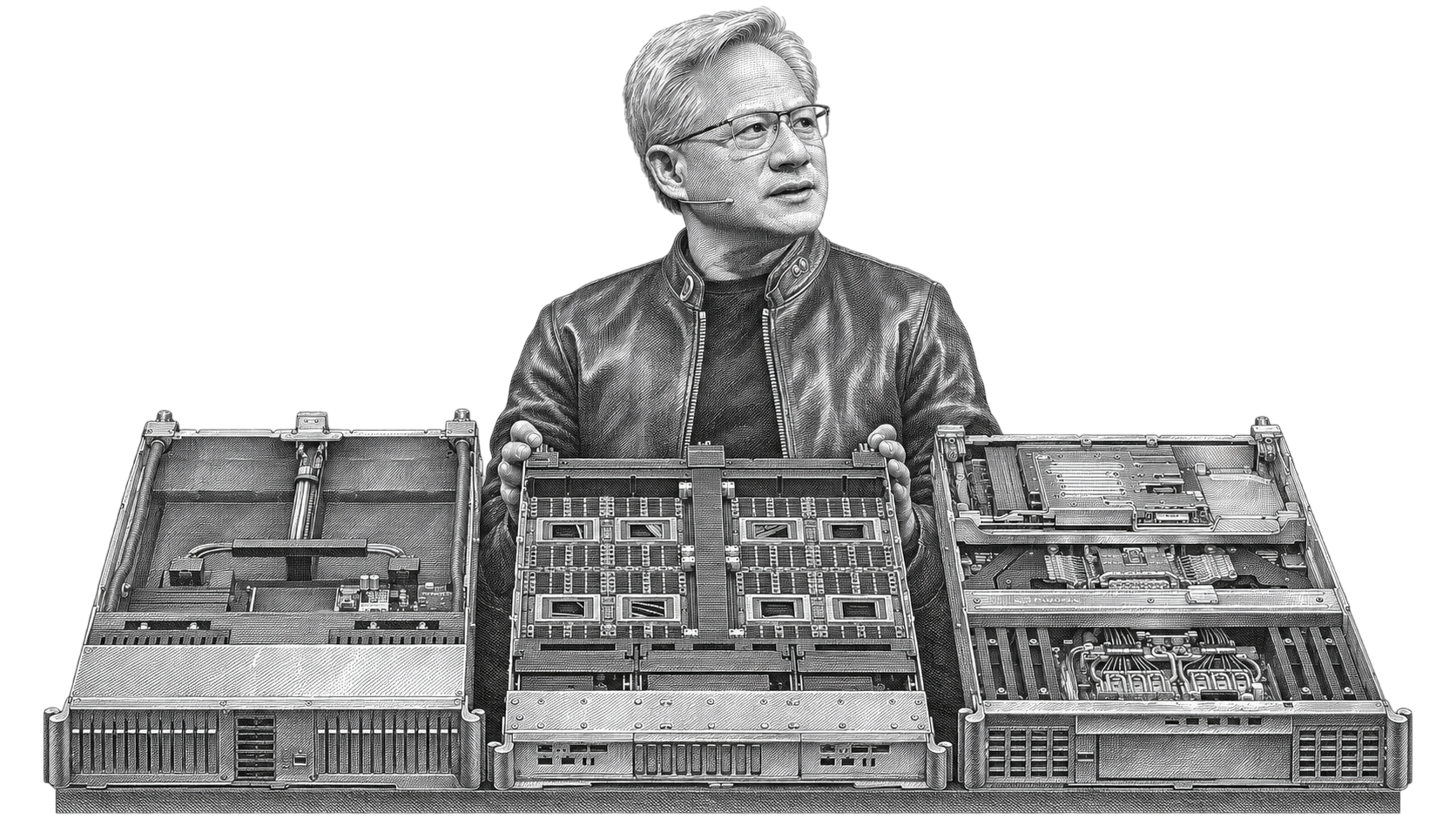
Jensen Huang, Nvidia
‘We don’t steal market share, we create markets.’
Bottom Up
Jensen Huang has never been afraid to get his hands dirty. Born in Taiwan in 1963, he was sent at nine to a Kentucky school for troubled children, which his parents had mistaken for a respectable boarding school. Much younger than his classmates, he was bullied and assigned to clean the dorm bathrooms. As a teenager, he worked his way up from dishwasher and bathroom cleaner to waiter at a Denny’s diner. As he likes to say, ‘I did more bathrooms than any CEO in the history of CEOs.’
Ahead of his years and gifted at maths, Jensen enrolled at Oregon State University at 16 to study electrical engineering, the start of a path that led to designing chips at AMD and LSI Logic. There, he recognised that computer processors handled tasks one at a time, while the hardest problems, from 3D graphics to scientific simulation, needed millions of calculations at once. To Jensen this was not a limit of computing, but a market no one had yet built.
In late 1992, Jensen returned to Denny’s with a much bigger idea. Over bottomless coffee in a San Jose booth, he and fellow engineers Chris Malachowsky and Curtis Priem worked out how to build a company around it. In 1993, with just US$40,000 between them, they founded Nvidia. The name came from invidia, the Latin word for envy, an apt choice for a business that would one day be the envy of the technology world.
Turning Failure into Edge
The early years nearly ended the company. Nvidia’s first chip failed to find buyers, and a contract with Sega to build the graphics chip for its next console became its lifeline. A year in, Jensen realised Nvidia had backed the wrong design. As he put it, ‘we would finish the project and die, or not finish the project and die right away.’ He flew to Japan, admitted to Sega’s chief executive that Nvidia’s design was flawed and advised him to find another partner. Then he made a bold request: that Sega pay Nvidia anyway, because without the money the company would not survive. Remarkably, Sega agreed to invest US$5 million. It was enough to keep the lights on for about six months, and Nvidia would not waste a day of it.
The problem ran deeper than one chip. As Jensen admitted, ‘Not only did we choose the wrong technology, we didn’t know how to do it the right way.’ He bought three textbooks on 3D graphics, and the team learned the industry standard from scratch. With no time or money for the usual cycle of prototypes, Jensen spent about a third of Nvidia’s remaining cash on an emulator to test the chip in software. Nvidia went straight to production without a working prototype, an approach almost unheard of at the time. Launched in 1997, the RIVA 128 sold more than a million units in four months and saved the company. Emulation became standard practice, letting Nvidia release new chips every six months while rivals took twice as long.
Tomorrow’s Market has no Customers Today
Nvidia’s most consequential decision came in 2006 with CUDA, the software that took the GPU beyond graphics Jensen built it into every chip, weighing on profits for years as investors questioned the strategy. He believed scientists and engineers would one day need that kind of computing power. The breakthrough came in 2012, when researchers used Nvidia graphics cards to train AlexNet, an AI model that taught itself to recognise images. Its success kick-started the deep learning revolution.
As AI models grew, so did the computing power needed to train them. Nvidia responded by building complete systems, linking thousands of GPUs into what Jensen calls ‘AI factories.’ The graphics chipmaker had become the foundation of modern AI.
The World’s Most Valuable Company, Ever
More than three decades after that Denny’s booth, Nvidia is closing in on a US$6 trillion valuation, the highest of any company in history. Yet behind the seemingly overnight rise is a founder who refused to let Nvidia fail, had the humility to change course when his design was wrong and backed CUDA years before it paid off. His greatest successes have come not from winning existing markets, but from creating new ones.
Please note that these are the views of the writer and not necessarily the views of Ziller. This article does not take into account your investment objectives, particular needs, or financial situation.