

AFR – Alex Gluyas – Markets reporter
Since Joseph Ziller was a kid, he’s always been fascinated by brilliant business minds. So when the fund manager came across then 32-year-old tech whizz Dylan Field last year, he knew he was onto something special.
Field possessed all the signs of a genius, including mastering algebra by age six. At school, he preferred to spend time with a janitor who was also a maths savant – someone with exceptional mathematical ability – and at university, Field received the prestigious Thiel Fellowship – a $US100,000 ($154,873) grant for students willing to leave university to pursue bold ideas.
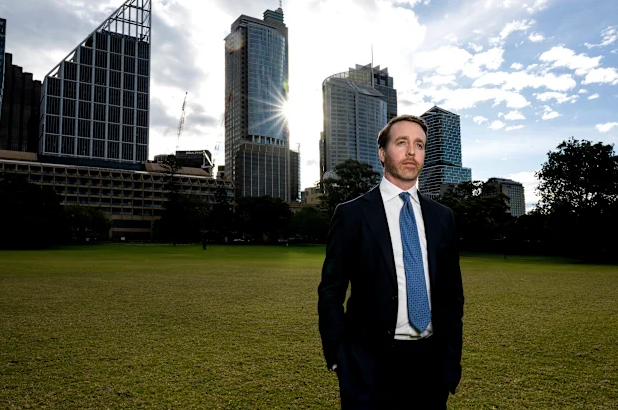
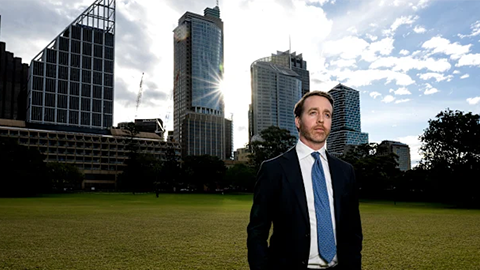
Ziller spent 11 years at Maple-Brown Abbott before starting his own firm in 2022. Louise Kennerley
Fast forward 13 years and Field’s design software company Figma has become the hottest name on Wall Street. The stock rocketed 250 per cent when it debuted on the New York Stock Exchange last week after completing a $US1.2 billion initial public offering.
Figma, which is a design tool that lets teams collaborate in real time on digital products such as websites and apps, is the most recent addition to Ziller Funds Management’s $10.4 million Founders Global Fund – a portfolio of 15 to 25 high-growth companies run by “exceptional founders”.
Ziller, who spent 11 years at Maple-Brown Abbott before going out on his own, was particularly impressed by Field’s ability to expand Figma’s customer base beyond its initial target of designers – two-thirds of the 13 million monthly active users are non-designers.
“The ability to grow a business far beyond its expected total addressable market is a real source of alpha,” Ziller says. “This is something we frequently see in founders that hit our sweet spot – excelling at execution and innovation.”
When making a stock pick, Ziller uses a ranking system that assesses founders on two core measures: output, which determines whether a person has a high or low impact on the business, and quality to determine whether that impact is fuelled by selflessness and love or fear and anxiety.
That framework has helped Ziller filter the roughly 800 founder-led publicly listed companies around the world down to 100 candidates. That list is then slowly whittled down to 50 based on fundamental analysis, before just 15 to 25 shares make it into the fund.
A high bar
It’s a rigorous process, but it has paid dividends since the fund’s inception in 2022, with a 37.1 per cent annual return. For the 2025 financial year, the strategy returned a whopping 50.4 per cent, net of fees.
One of its biggest winners has been Nasdaq-listed Palantir, which develops powerful analytics platforms used by governments and businesses to make sense of vast, complex datasets.
Palantir was among Ziller’s first stock picks for the fund when the shares were lumbering around $US8.64 after its much-hyped IPO in 2020 fell short of expectations.
Investors were worried that the engineers that Palantir sends out to clients to help customise its software made it more akin to a crummy labour hire business than a monopoly software-as-a-service company.
But Ziller viewed the business model as a reflection of the culture that co-founders Alex Karp and Peter Thiel were cultivating.
“It was very unusual for a SaaS business to actually care about solving a customer’s biggest problems through deploying labour out to their business, so that was their point of difference,” Ziller says.
“What we try and do by focusing on founders and culture is to be early on stocks by seeing quality emerge before others – predicting that emergence in quality is where a lot of money can be made.”
Palantir shares are now trading at around $US158 apiece, some 1728 per cent higher than Ziller’s entry price. And while he has taken some profits over the past six months, the fund still holds a 3.5 per cent position in the stock.
His largest holding is Rocket Lab, which designs and launches small rockets to deliver satellites into orbit.
Since Ziller initiated a position in December, the stock has already doubled as the company transitions from using smaller rockets to a medium-sized product called Neutron, which can carry a heavier load.
While the so-called medium launch market is dominated by Elon Musk’s SpaceX, Ziller says Rocket Lab will be able to win “as many launches as they can deliver” because of its founder Peter Beck.
“Beck already beat all competitors in the small launch market, some of which were so much better funded, so they’ve got that market tied up,” he explains.
Hedging Elon
“We know there is a track record of success for Beck, so there’s a good chance that if there is similar execution in the medium lift market, the stock is going to suddenly look very, very cheap.”
Rocket Lab is also a convenient hedge against Ziller’s Tesla holding. If sentiment sours on its billionaire founder Elon Musk, Rocket Lab will benefit from a shift away from SpaceX. If sentiment sweetens, Tesla should benefit.
Ziller has owned Tesla since 2022 because he believes Musk’s work persona is vastly different from how he acts in public.
“With some founders we see an ‘on the court’ and ‘off the court’ persona, so with Elon, there is a dramatic difference between the quality of his work at work, and the quality of person when he’s on Twitter,” Ziller says.
“What you hear from the majority of engineers that Elon works with is when he’s at work and thinking through engineering problems, he’s very much driven by reason and logic.”
Still, that hasn’t stopped Ziller from trimming his position in Tesla as Musk moved further into politics and spent less time at the electric vehicle giant. The firm still holds a 6.8 per cent position in its fund.
Another portfolio hedge against Musk’s antics is owning shares in Chinese EV maker XPeng, which is challenging Tesla in the autonomous vehicle market.
Ziller compares co-founder and chief executive He Xiaopeng’s resilience and tenacity to a young Elon Musk – a necessary trait in the highly competitive car market.
“His ability to get knocked down and get back up is second to none, and that’s what you really need in the Chinese EV auto market because it’s been a bloodbath – just surviving over the past few years has been impressive, but he’s also been able to move up and up,” Ziller says.
While picking winners has been crucial to returns – one of the fund’s top contributors was investing in chip giant Nvidia in 2022 – avoiding the laggards has been just as important.
Avoiding MinRes
“What tends to happen with founders is the very thing that can make their business great, can also be a risk,” he says. “So if a founder has a disproportionately large amount of control, that can be good if they have a history of executing, but can be very bad if the founder is low quality.”
Australian investors are all too familiar with the scandals that engulfed ASX founder-led darlings WiseTech Global and Mineral Resources, which sent the shares tumbling. Ziller avoided both because neither WiseTech’s Richard White nor MinRes’ Chris Ellison ranked highly enough in his assessment.
“They were both lower quality founders that did not meet the cut-off for the fund,” Ziller says simply.
But one stock that he is most excited about is Coinbase, a cryptocurrency exchange described as “the Amazon of crypto”.
The shares have soared nearly 50 per cent this year, propelled by the passing of the GENIUS Act in the US – the first regulatory framework for stablecoins, which are digital currencies pegged to another asset like the US dollar.
“Stablecoins look like they might become the ChatGPT moment for blockchain and crypto,” Ziller says.
He recently sold its position in BlackRock’s iShares Ethereum Trust exchange-traded fund for a tidy profit, after being drawn to Vitalik Buterin, the inventor of ethereum. But Ziller’s betting that the best way to play crypto is via Coinbase.
“It’s a genuine picks and shovels play on the whole blockchain crypto market – it touches all aspects of the ecosystem.”

Licensed by Copyright Agency. You must not copy this work without permission.