Investor Portal

Jensen Huang, Nvidia

Reading Time: 3 minutes

‘We don’t steal market share, we create markets.’

Bottom Up

Jensen Huang has never been afraid to get his hands dirty. Born in Taiwan in 1963, he was sent at nine to a Kentucky school for troubled children, which his parents had mistaken for a respectable boarding school. Much younger than his classmates, he was bullied and assigned to clean the dorm bathrooms. As a teenager, he worked his way up from dishwasher and bathroom cleaner to waiter at a Denny’s diner. As he likes to say, ‘I did more bathrooms than any CEO in the history of CEOs.’

Ahead of his years and gifted at maths, Jensen enrolled at Oregon State University at 16 to study electrical engineering, the start of a path that led to designing chips at AMD and LSI Logic. There, he recognised that computer processors handled tasks one at a time, while the hardest problems, from 3D graphics to scientific simulation, needed millions of calculations at once. To Jensen this was not a limit of computing, but a market no one had yet built.

In late 1992, Jensen returned to Denny’s with a much bigger idea. Over bottomless coffee in a San Jose booth, he and fellow engineers Chris Malachowsky and Curtis Priem worked out how to build a company around it. In 1993, with just US$40,000 between them, they founded Nvidia. The name came from invidia, the Latin word for envy, an apt choice for a business that would one day be the envy of the technology world.

Turning Failure into Edge

The early years nearly ended the company. Nvidia’s first chip failed to find buyers, and a contract with Sega to build the graphics chip for its next console became its lifeline. A year in, Jensen realised Nvidia had backed the wrong design. As he put it, ‘we would finish the project and die, or not finish the project and die right away.’ He flew to Japan, admitted to Sega’s chief executive that Nvidia’s design was flawed and advised him to find another partner. Then he made a bold request: that Sega pay Nvidia anyway, because without the money the company would not survive. Remarkably, Sega agreed to invest US$5 million. It was enough to keep the lights on for about six months, and Nvidia would not waste a day of it.

The problem ran deeper than one chip. As Jensen admitted, ‘Not only did we choose the wrong technology, we didn’t know how to do it the right way.’ He bought three textbooks on 3D graphics, and the team learned the industry standard from scratch. With no time or money for the usual cycle of prototypes, Jensen spent about a third of Nvidia’s remaining cash on an emulator to test the chip in software. Nvidia went straight to production without a working prototype, an approach almost unheard of at the time. Launched in 1997, the RIVA 128 sold more than a million units in four months and saved the company. Emulation became standard practice, letting Nvidia release new chips every six months while rivals took twice as long.

Tomorrow’s Market has no Customers Today

Nvidia’s most consequential decision came in 2006 with CUDA, the software that took the GPU beyond graphics Jensen built it into every chip, weighing on profits for years as investors questioned the strategy. He believed scientists and engineers would one day need that kind of computing power. The breakthrough came in 2012, when researchers used Nvidia graphics cards to train AlexNet, an AI model that taught itself to recognise images. Its success kick-started the deep learning revolution.

As AI models grew, so did the computing power needed to train them. Nvidia responded by building complete systems, linking thousands of GPUs into what Jensen calls ‘AI factories.’ The graphics chipmaker had become the foundation of modern AI.

The World’s Most Valuable Company, Ever

More than three decades after that Denny’s booth, Nvidia is closing in on a US$6 trillion valuation, the highest of any company in history. Yet behind the seemingly overnight rise is a founder who refused to let Nvidia fail, had the humility to change course when his design was wrong and backed CUDA years before it paid off. His greatest successes have come not from winning existing markets, but from creating new ones.
Coinbase

Reading Time: 3 minutes

Coinbase is the leading U.S. cryptocurrency exchange and custody platform; effectively the “picks and shovels” provider of the digital-asset economy. Founded in 2012 by Brian Armstrong and Fred Ehrsam, Coinbase has become the most trusted gateway for both retail and institutional participants, serving over 120 million verified users and holding more than US $500 billion in customer assets. It dominates the U.S. retail crypto market and anchors the institutional ecosystem as custodian and execution partner for nearly all newly approved Bitcoin and Ethereum ETFs.

The Blockchain Decade

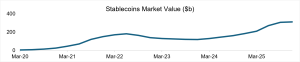
Stablecoins settled roughly US $46 trillion in 2025, more than Visa and Mastercard combined across a broader range of financial activity. At the same time, regulatory clarity in the U.S. (stablecoin GENIUS Act and CFTC comprehensive proposal) and Europe is unlocking institutional participation, with asset managers, banks, and fintechs seeking compliant partners. Particularly in the U.S., the White House has launched a coordinated push to position the nation as “the Crypto Capital of the World.”

Arms Strong

Armstrong’s philosophy “an open financial system for the world” has guided Coinbase from exchange to full-stack infrastructure provider. A self-described “product-focused CEO,” he has incessantly pursued long-range investments in compliance, custody, and developer platforms. Of the early major exchanges, nearly all failed, committed fraud, or fled offshore. This stability of vision and control has allowed Coinbase to expand into staking, stablecoins, and on-chain infrastructure without losing focus on regulatory legitimacy; the central differentiator of the franchise.

License as Moat

Coinbase is the most regulation-ready and audit-hardened platform at scale in crypto. From inception, it chose to operate transparently under U.S. and global financial regulations. This compliance-first DNA has now become a durable advantage as regulators tighten standards and many offshore or underregulated competitors retreat or unwind. Coinbase is the natural partner for institutions, ETFs and banks that require compliant infrastructure.

The ‘Amazon’ of Crypto

Coinbase is becoming more than a place to buy and sell crypto. Trading brings customers in; custody and staking keep their assets on the platform; USDC lets them move and spend money; and Base provides the infrastructure layer for a growing ecosystem of on-chain apps and financial activity. This means Coinbase can earn from the same customer in several ways. It makes money from trading and custody, whilst earning interest income through USDC.


Source: CoinGecko

How do AI Pay?

AI agents will increasingly need to pay for data, software and computing from one another. Many of these purchases could be fractions of a cent and occur thousands or millions of times automatically. Traditional card rails, with minimum fees, intermediaries and human accounts, are poorly suited to this kind of activity. Coinbase already has much of the infrastructure ready – USDC provides the money, Base moves it cheaply, and x402 lets AI agents pay businesses automatically over the internet. With x402 already processing more than 50 million transactions, Coinbase is becoming an important payment rail for the emerging machine economy, much as card networks enabled internet commerce.

Financials

Since listing, Coinbase’s revenue has grown ~59% annually. We model ~29% annual growth through FY31 as Coinbase expands beyond trading into the broader infrastructure of the on-chain economy: institutional custody and prime services, stablecoins and payments, staking, Base, and developer infrastructure. We forecast EBIT margins to expand from 22% toward ~34% by FY31 driven by software-like scalability, fewer intermediaries than in traditional brokerage, and a higher fee base (~30 bps vs 3 bps for equities).

Valuation

At current valuation levels (~35 forward P/E), Coinbase offers an attractive exposure to the most trusted operating system for the on-chain economy. Our Total Rate of Return estimate for the company is >20% pa over the next 5 years.

Buy Hold Sell: Berkshire, Palantir and 3 more founder-led stocks

Reading Time: 2 minutes

Joseph Ziller appeared in a recent episode with Livewire Markets “Buy Hold Sell” where he shares his views on founder-led businesses including Palantir, Berkshire Hathaway and Roblox.

Watch the full episode below.

Disclaimer: Please note that these are the views of the writer and not necessarily the views of and Ziller Funds Management Pty Limited (ABN 88 688 720 578) (Ziller) as a Corporate Authorised Representative (CAR 1317129) of Perennial Value Management Limited (ABN 22 090 879 904, AFSL No. 247293) (PVM). Perennial Investment Management Limited (ABN 13 108 747 637, AFSL No. 275101) (PIML) is the Responsible Entity. Ziller, PIML and PVM are part of Perennial Partners Limited (ABN 90 612 829 160, CAR 1293138 of PVM) (Perennial Partners).

This video contains general advice only and does not take account of your objectives, financial situation or needs. Before acting on this general advice you should consider the appropriateness of the advice having regard to your objectives, financial situation and needs. You should obtain and consider the relevant Product Disclosure Statement (PDS) and Target Market Determination (TMD) relating to any financial product referred to in this document before deciding whether to acquire, continue to hold or dispose of that product. The current relevant Target Market Determination, Product Disclosure Statement, and application forms can be found on Ziller’s website at www.zillerfm.com. This document is based on information obtained from sources believed to be reliable and accurate at the time of publication; however, no representation or warranty is made as to its accuracy, completeness or currency. There are risks involved in investing. The value of investments can and does fluctuate, and an individual investment may become valueless. Past performance is not a reliable indicator of future performance. Nothing contained in this document should be construed as a solicitation to buy or sell any security or financial product, or to engage in or refrain from engaging in any transaction. To the extent permitted by law, neither Ziller, PIML, PVM nor any related entity accepts liability for any loss or damage arising directly or indirectly from reliance on the information contained in this document.

The views, opinions or recommendations of the author in this article are solely those of the author and do not in any way reflect the views, opinions, recommendations, of ASX Limited ABN 98 008 624 691 and its related bodies corporate (“ASX”). ASX makes no representation or warranty with respect to the accuracy, completeness or currency of the content. The content is for educational purposes only and does not constitute financial advice.  Independent advice should be obtained from an Australian financial services licensee before making investment decisions. To the extent permitted by law, ASX excludes all liability for any loss or damage arising in any way due to or in connection with the publication of this article, including by way of negligence.

Fortinet

Reading Time: 2 minutes

Despite the backdrop of the “SaaSpocalypse” and a sharp derating across software, Fortinet has rallied 121% year to date. The performance reflects continued earnings delivery and growing recognition of a differentiated cybersecurity platform. Fortinet is a global leader in cybersecurity, serving over 900,000 customers through one of the industry’s most comprehensive and integrated security platforms. Founded in 2000 by brothers Ken and Michael Xie, the company has evolved from a firewall business into a broad security operating system.

Built for the Long Game

Ken and Michael Xie built Fortinet around the view that cybersecurity was fundamentally an infrastructure-engineering problem. Their leadership has been defined by long-term vision, organic innovation and an engineering-driven culture. While hardware was increasingly viewed as legacy, the Xie brothers doubled down on proprietary ASICs and a single FortiOS architecture. Over 25 years, that conviction has transformed Fortinet from a firewall vendor into an integrated platform spanning more than 50 enterprise-grade products, while delivering superior security performance at lower cost.

A Growing Need for Security

Fortinet operates across a large and expanding cybersecurity market exceeding US$184bn, including Secure Networking, Unified SASE and AI-driven Security Operations. Rising cyber complexity, AI-driven attack volumes and the convergence of networking and security are increasing the need for real-time, cost-efficient protection. At the same time, enterprises are increasingly consolidating fragmented security stacks, favouring integrated platforms such as Fortinet.

Architecture Advantage

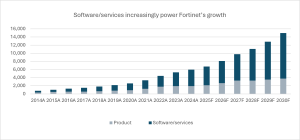
Fortinet has built one of the industry’s most deeply integrated cybersecurity architectures, combining proprietary hardware, software and security intelligence under a single operating system. This reduces R&D duplication, improves deployment efficiency and enables ASIC-accelerated performance. FortiGate also provides a powerful entry point into customers – around 90% begin with the firewall before expanding into SASE, XDR, email and other security products. Evidently, Fortinet has delivered a 10-year revenue CAGR of 23%, including 26% growth in services.

Source: Company filings, Ziller expectations. Forecasts subject to change.

A Lesson in AI

Fortinet may also be an early example of a broader reappraisal now taking place across software. In that AI disruption will not affect every software business equally. As sentiment begins to recover across the sector, we believe the opportunity lies in distinguishing businesses with durable data, workflows, architecture and competitive advantages from those whose value can be more easily commoditised.

A Winner at a Fuller Valuation

Fortinet has been a strong investment for Ziller, with the underlying thesis playing out through continued market-share gains, earnings growth and platform expansion. That said, the significant share-price appreciation over the past year has reduced the prospective TRR from previous levels. We have therefore begun trimming the position, realising gains while still retaining exposure to a high-quality cybersecurity leader.

Buy Hold Sell: A mega Mag 7 special

Reading Time: 2 minutes

Buy Hold Sell: A mega Mag 7 special

Joseph Ziller appeared in a recent episode with Livewire Markets “Buy Hold Sell” on 20 August 2026 where he weighed in on seven mega-cap stocks including Apple, Nvidia and Tesla, and how each is placed to navigate the new AI landscape.

Watch the full episode below.

Please note this video was filmed on 20 August 2026.

Disclaimer: Please note that these are the views of the writer and not necessarily the views of and Ziller Funds Management Pty Limited (ABN 88 688 720 578) (Ziller) as a Corporate Authorised Representative (CAR 1317129) of Perennial Value Management Limited (ABN 22 090 879 904, AFSL No. 247293) (PVM). Perennial Investment Management Limited (ABN 13 108 747 637, AFSL No. 275101) (PIML) is the Responsible Entity. Ziller, PIML and PVM are part of Perennial Partners Limited (ABN 90 612 829 160, CAR 1293138 of PVM) (Perennial Partners).

This video contains general advice only and does not take account of your objectives, financial situation or needs. Before acting on this general advice you should consider the appropriateness of the advice having regard to your objectives, financial situation and needs. You should obtain and consider the relevant Product Disclosure Statement (PDS) and Target Market Determination (TMD) relating to any financial product referred to in this document before deciding whether to acquire, continue to hold or dispose of that product. The current relevant Target Market Determination, Product Disclosure Statement, and application forms can be found on Ziller’s website at www.zillerfm.com. This document is based on information obtained from sources believed to be reliable and accurate at the time of publication; however, no representation or warranty is made as to its accuracy, completeness or currency. There are risks involved in investing. The value of investments can and does fluctuate, and an individual investment may become valueless. Past performance is not a reliable indicator of future performance. Nothing contained in this document should be construed as a solicitation to buy or sell any security or financial product, or to engage in or refrain from engaging in any transaction. To the extent permitted by law, neither Ziller, PIML, PVM nor any related entity accepts liability for any loss or damage arising directly or indirectly from reliance on the information contained in this document.

The views, opinions or recommendations of the author in this article are solely those of the author and do not in any way reflect the views, opinions, recommendations, of ASX Limited ABN 98 008 624 691 and its related bodies corporate (“ASX”). ASX makes no representation or warranty with respect to the accuracy, completeness or currency of the content. The content is for educational purposes only and does not constitute financial advice.  Independent advice should be obtained from an Australian financial services licensee before making investment decisions. To the extent permitted by law, ASX excludes all liability for any loss or damage arising in any way due to or in connection with the publication of this article, including by way of negligence.

Benchmark investors face growth gap as firms delay listing

Reading Time: 2 minutes

Financial Newswire – Binaya Dahal

Investors relying on traditional market benchmarks risk missing many of the structural growth themes expected to drive the global economy over the coming decade, as potential market leaders stay private for longer, according to Ziller Funds Management.

Joe Ziller, founder and chief investment officer of the Sydney-based asset manager, said the advance of artificial intelligence (AI), private capital and founder-led innovation were reshaping global equity markets and changing where future growth opportunities were being created.

“Investors have traditionally looked to listed markets to identify tomorrow’s winners,” Ziller said.

“Increasingly, many of tomorrow’s most important businesses are reaching enormous scale before they ever list. That has significant implications for how investors think about long-term portfolio construction.”

Speaking at an investor briefing this week, Ziller warned that the shift could leave benchmark-focused investors underexposed to some of the fastest-growing parts of the global economy.

He said sectors including AI, digital infrastructure, fintech, cybersecurity and space technology will likely account for about 56% of global GDP growth over the next decade, despite representing only around 32% of today’s equity indices.

“The economics of company building are changing,” Ziller said.

“For decades, founders were constrained by access to capital, the need for significant physical infrastructure and the challenge of scaling large workforces. Those barriers are falling simultaneously.”

He said AI was enabling businesses to generate significantly greater output with fewer employees, accelerating the pace at which companies can scale.

Ziller noted that AI-native companies were drawing around US$3.5 million in revenue per employee, approximately six times that of traditional software businesses.

“The result is that exceptional founders can build globally significant businesses faster than at any point in history,” he said.

“Taking an active view in this share of the market has never been more important.”

Read the original article on Financial Newswire.

Licensed by Copyright Agency. You must not copy this work without permission.

The Founder Constant

Reading Time: 2 minutes

Every generation tends to regard its era as historically unique. The dominance of founder-led companies built by figures such as Jeff Bezos, Bill Gates, Jensen Huang and Elon Musk can make founder advantage seem like a byproduct of software, the internet or AI. They appear singular because the technologies they command are new, the scale of their companies is immense, and the systems around them feel unprecedented. Yet this is not new.

The Same Pattern

The clearest way to understand this is to look at past products and focus on the few key people that drove them. In the 18th century, Richard Arkwright helped industrialise production through mechanised textiles. A century later, during The Gilded Age, Andrew Carnegie supplied the material backbone of America through steel, Thomas Edison helped commercialise electrification at system scale, John D. Rockefeller organised the oil base of the industrial age. Whilst not too long ago, Gordon Moore stood at the centre of the semiconductor revolution.

These were not marginal developments, in fact, steam and textiles accounted for roughly 28% of GDP growth in their era, railways 17%, steel and electrification 14%, oil 16%, and semiconductors 14%.

It is not simply that these were important industries. It is that, across radically different periods, economic growth repeatedly concentrated around a small number of foundational themes, and the leading founders around those themes captured disproportionately extraordinary value.

Few Who Shape the Many

As Peter Thiel observes:

“Never forget that a small group of highly competent but slightly absurd folks can change the world; indeed, it’s the only thing that ever has.”

Of the 50 US-listed companies that have generated the most shareholder wealth since 1926, 31 were founder-led at some point during their public lives. Ranked by annualised returns, 17 of the top 20 were founder-led.

It includes familiar names such as Steve Jobs (Apple), Bill Gates (Microsoft), Jeff Bezos (Amazon), Mark Zuckerberg (Meta), and Larry Ellison (Oracle), but also founders from much earlier eras and very different sectors, including Sam Walton (Walmart), Walt Disney (Disney), and Bernie Marcus (Home Depot).

Why This Still Matters Today

Seen this way, the defining founders of the present are not without precedent. The enduring point is that founder-led outperformance has accompanied every major period and is why the strongest founders continue to matter so much.

In an era of unseen pace of change and new questions, this principle becomes even more powerful. As Jim Collins argues in his book Good to Great,

“The more uncertain the world, the more you want to bet on the who, not the what, because the what’s are going to change.”

SaaSpocalypse was a buying opportunity. This manager took it

Reading Time: 6 minutes

Joseph Ziller explains why he bought founder-led SaaSpocalypse stocks on the way down and the reason a defence IPO is on his watchlist.

When tech stocks took a beating earlier this year over fears of AI disruption, it created an opportunity for Joseph Ziller. As the founder and CIO of Ziller Funds Management, a lot of businesses that fall under his founder-led investment strategy tumbled to more attractive valuations.

Among the buys were names like Pro Medicus and Axon Enterprise, which have both experienced strong recoveries after deep drops. It’s a strong argument for Ziller’s founder focus, where he goes beyond the financials and looks at the person running the show.

That’s also the rationale behind his latest watchlist pick. It’s not a company that investors can find on the public markets yet, but with chatter about an IPO on the horizon, Ziller is keeping an eye on defence products firm Anduril.

In this Q&A, Ziller breaks down the case for the SaaSpocalypse stocks that are making a recovery, why SpaceX’s post-IPO sell-off is this week’s win, and shares the piece of advice he gives to every new investor.


Ziller Funds Management’s Joseph Ziller


What’s your most recent investment and why?

Pro Medicus () — our first Australian holding, purchased in February. We’d tracked it since the Fund’s inception in 2022: it passed our Founder and Business filters from day one, but the valuation only recently became attractive.

Founder-CEO Dr Sam Hupert is a rare combination — the clinical insight of a practising physician with the relentless execution of a tech entrepreneur. Visage 7, the company’s imaging platform, is the technology benchmark in radiology software: its streaming architecture opens even the largest studies in under a second, which is why it has become the platform of choice for America’s top academic health systems.

The AI-driven derating of software stocks over the past year — the so-called SaaSpocalypse — offered us a compelling entry point in February. Over time, we believe it will become clearer that Pro Medicus is a beneficiary of AI as imaging volumes grow and AI tools get deployed through exactly the kind of platform Visage has built.

Which investment did you add to your watchlist this week?

We run a tight global focus list of 80 structural winners led by exceptional founders. No changes this week — but alongside it we track the IPO pipeline for names in our hitting zone, and we added one: Anduril (Defence Tech), founded by Palmer Luckey.

As a teenager, Luckey amassed the world’s largest private collection of VR headsets and built his own prototypes in his parents’ garage, funding the work by repairing phones and cleaning boats. When his future co-founders first saw the Oculus Rift, it was a tape-covered brick buried under cables. Within two years, Facebook bought Oculus for US$2 billion.

Anduril is the second act: a US defence company built to mass-produce low-cost autonomous systems. It funds development with its own capital and sells finished products at fixed prices — the inverse of the primes’ cost-plus model. Cheap, scalable autonomy is the thesis here.

“We’re not a defence contractor — we’re a defence products company. When we fail to make a product that works, we don’t get paid… Imagine if the iPhone had been built on a cost-plus contract — it wouldn’t have worked.” — Palmer Luckey

What is the most recent investment you have trimmed or sold and what drove this decision?

Axon Enterprise (). We added through the SaaSpocalypse and the stock rallied 80% from its April lows to its early-July peak. We trimmed into that strength as valuation became less compelling.

Since listing in 2001, Axon has compounded at more than 30% a year — a total return of ~100,000%. Founder Rick Smith started the business with a personal mission — to make the bullet obsolete — after two friends were killed in a shooting. Thirty-three years on, he still runs it, still owns it, and is still obsessed with it.

Tasers, body cameras, digital evidence — Axon is the operating system of American policing. At the centre sits Axon Evidence: 400+ petabytes of mission-critical data across more than 18,000 agencies. Churn is close to zero as switching providers risks compromising evidence in live prosecutions.

The SaaS sell-off was an opportunity to double down on a rare compounder at a rare price — mispriced on the same fear that hit Pro Medicus: that AI kills the software incumbent. Both own the layer AI must ship through to reach the end user.

For Axon that’s the point of capture — cameras and Tasers at the edge — and the evidence data behind it, so AI in policing arrives through Axon as revenue, not against it as competition. Quarterly results are proving this out with AI revenue growing roughly 700% year-on-year last quarter.

What’s your favourite chart or data point from this week?

One I was thinking about a bit this week.. a chart posted by Brian Armstrong, Founder and CEO of Coinbase (portfolio holding) on AI token spend. As tech-forward companies lean into the power of AI, the explosion in token spend is becoming a key financial bottleneck. Brian detailed how Coinbase has managed to halve their token costs while increasing their token usage.

One of the interesting implications for us, as holders of Palantir as well, is that Palantir’s Ontology — its pre-built ‘dictionary’ of every enterprise’s data, workflows, and assets — is exactly the infrastructure that solves this problem at scale for enterprises: rather than each AI agent burning expensive tokens reconstructing context from scratch, Palantir as orchestrator hands it a precise, pre-labelled briefing, meaning companies running Palantir’s platform can grow their AI usage without a proportional blowout in compute costs.

Source: Coinbase
Source: Coinbase

What was your weekly high – a standout market moment or highlight?

SpaceX () sold-off back to IPO levels. We are keen buyers of SpaceX at the right price and are excited about the growing opportunity to own this stock. Low-cost reliable launch is in scarce supply with SpaceX having a near monopoly here.

By owning this short supply, SpaceX has one of the few sets of keys unlocking the application layer. For example, SpaceX’s Communication division grew revenue 50% last year at high 30s operating margin with the division now representing ~60% of SpaceX’s total revenue.

What was your weekly low – a market disappointment or challenge from the week?

Memory stocks ripping early in the week. We are believers in the AI infrastructure rollout and are positioned accordingly, however, we have aligned with businesses with higher through-the-cycle returns on capital.

What first drew you to markets or this sector and what continues to keep you inspired today?

My mum was a counsellor, and my dad was a banker. What drew me to markets and one aspect that I still love today is learning about the people behind the numbers. The brilliant leaders. We’ve found there to be asymmetric upside here, with the best leaders often deeply undervalued in the market. This is the core thesis of our Fund.

What’s one piece of advice you’d give to new investors?

There are experts who have a track record of being right and experts who have a track record of eloquent reasoning. When they disagree, which can be often, follow the one with the track-record of being right.

How do you unwind when you’re not thinking about the market?

Nature walks with my wife.

Joseph Ziller and his wife.

Rapid fire!

What is your favourite investing book?

The Outsiders — William Thorndike.

What is your favourite investing or finance/markets related podcast?

How I Built This with Guy Raz.

What’s the first thing you read each morning?

My top follows for each portfolio holding on X.

What is your favourite restaurant?

Bessie’s & Alma’s.

What’s something people are surprised to learn about you?

I counted cards at the casino during university.


Read the original article on Livewire

Licensed by Copyright Agency. You must not copy this work without permission.

SpaceX

Reading Time: 3 minutes

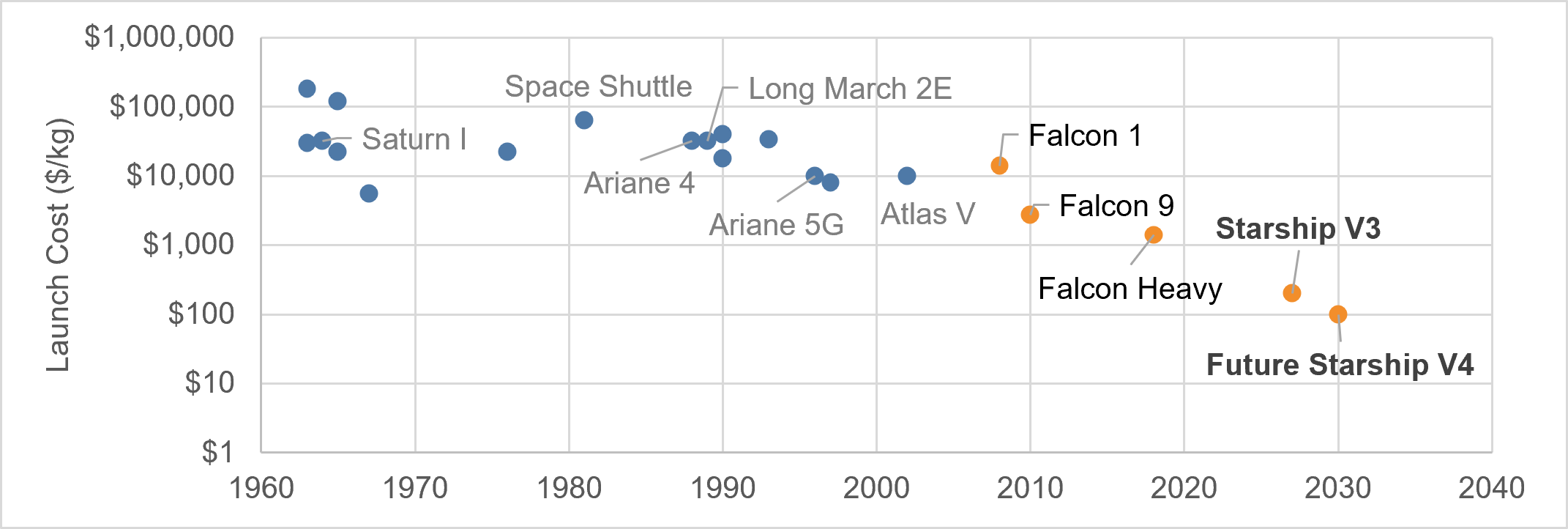
SpaceX is the defining company of the new space economy. Founded by Elon Musk in 2002 to make humanity multiplanetary, the company has transformed launch from a bespoke aerospace activity into a reusable, high-volume industrial platform. It now controls the core physical layers behind the next generation of space infrastructure; low-cost launch, satellite manufacturing, global connectivity, and increasingly (terrestrial) AI compute. In 2025, SpaceX completed 170 launches, carried 2,200 metric tons to orbit – more than the rest of the world combined – and represented more than 80% of all mass launched to orbit.

The Algorithm

Elon Musk’s defining contribution has been to reframe aerospace through first-principles engineering and industrial scale. SpaceX was founded on the belief that rockets were expensive not because of physics alone, but because of inefficient processes, fragmented supply chains, and low-volume production. Musk’s response was to vertically integrate aggressively, simplify systems, iterate rapidly, and continuously compress cost curves. The company formalised this philosophy internally through “The Algorithm”: question requirements, delete unnecessary parts and processes, optimise only what remains, accelerate cycle time, and automate last.

Industrialisation of Space

Starlink is the clearest commercial proof of SpaceX’s launch advantage. It converts low-cost access to orbit into recurring revenue. On a scale unmatched, Starlink operates over 9,600 satellites and represented roughly 75% of all active maneuverable satellites in orbit. Starship, the largest and most powerful vehicle of any kind ever developed, is designed to carry over 100 metric tons to orbit in a fully reusable configuration, which will materially lower the cost of deploying satellites, communications infrastructure, and orbital compute.

Source: SpaceX and Ziller Funds Management | Constant 2021 $ per kilogram; plotted on a logarithmic axis

Orbit, Bandwidth and Compute

SpaceX is the only owner across all three scarce physical capacity – orbit, bandwidth, and compute. The company frames its long-term opportunity around a very large addressable market, estimating a quantifiable TAM at approximately $28.5tn, including $370bn in Space, $1.6tn in Connectivity, and $26.5tn in AI. Importantly, these markets reinforce one another. Launch enables satellites. Satellites enable global bandwidth. Bandwidth supports compute distribution. Distributed compute creates the next major infrastructure layer, AI.

SpaceX’s AI strategy is therefore an extension of the same playbook. AI growth is increasingly constrained by power, chips, and data centre construction. SpaceX’s “from shovels to tokens” approach attacks these bottlenecks directly by controlling physical infrastructure from power generation through to compute deployment. The Anthropic and Google agreement, under which SpaceX will provide access to COLOSSUS and COLOSSUS II capacity for $2.1bn per month through 2029, demonstrates that compute infrastructure is already monetisable at scale.

Valuation

The value of launch providers such as SpaceX and Rocket Lab has rallied substantially across public and private markets over the past few years. Ziller Global Fund has participated in this rally through our investment in Rocket Lab since late 2024. Given the elevated valuation at IPO, we chose not to participate in the SpaceX offering, but continue to monitor the stock closely for an attractive entry point.

SpaceX is expected to grow revenue by 81% in FY26, 61% in FY27, 49% in FY30, driven primarily by Starlink and terrestrial data centre monetisation. Our current Total Rate of Return estimate for SpaceX is approximately 10% p.a. over the next five years. Near term, the factors we are monitoring most closely are the pace of terrestrial data centre buildout, achieved compute rental rates, and progress in AI model monetisation (Cursor and broader enterprise adoption).

Brilliant Investment Thinkers. Podcast

Reading Time: 2 minutes

Brilliant Investment Thinkers. Podcast.

In this episode Joseph Ziller, from Ziller Funds Management, covers how to assess founder quality beyond the financials, the red flags that disqualify an otherwise compelling business, what it takes to run a concentrated global portfolio with real conviction, and how to think about valuation when the best companies rarely look cheap.

Disclaimer: Please note that these are the views of the writer and not necessarily the views of and Ziller Funds Management Pty Limited (ABN 88 688 720 578) (Ziller) as a Corporate Authorised Representative (CAR 1317129) of Perennial Value Management Limited (ABN 22 090 879 904, AFSL No. 247293) (PVM). Perennial Investment Management Limited (ABN 13 108 747 637, AFSL No. 275101) (PIML) is the Responsible Entity. Ziller, PIML and PVM are part of Perennial Partners Limited (ABN 90 612 829 160, CAR 1293138 of PVM) (Perennial Partners).

This video contains general advice only and does not take account of your objectives, financial situation or needs. Before acting on this general advice you should consider the appropriateness of the advice having regard to your objectives, financial situation and needs. You should obtain and consider the relevant Product Disclosure Statement (PDS) and Target Market Determination (TMD) relating to any financial product referred to in this document before deciding whether to acquire, continue to hold or dispose of that product. The current relevant Target Market Determination, Product Disclosure Statement, and application forms can be found on Ziller’s website at www.zillerfm.com. This document is based on information obtained from sources believed to be reliable and accurate at the time of publication; however, no representation or warranty is made as to its accuracy, completeness or currency. There are risks involved in investing. The value of investments can and does fluctuate, and an individual investment may become valueless. Past performance is not a reliable indicator of future performance. Nothing contained in this document should be construed as a solicitation to buy or sell any security or financial product, or to engage in or refrain from engaging in any transaction. To the extent permitted by law, neither Ziller, PIML, PVM nor any related entity accepts liability for any loss or damage arising directly or indirectly from reliance on the information contained in this document.

The views, opinions or recommendations of the author in this article are solely those of the author and do not in any way reflect the views, opinions, recommendations, of ASX Limited ABN 98 008 624 691 and its related bodies corporate (“ASX”). ASX makes no representation or warranty with respect to the accuracy, completeness or currency of the content. The content is for educational purposes only and does not constitute financial advice.  Independent advice should be obtained from an Australian financial services licensee before making investment decisions. To the extent permitted by law, ASX excludes all liability for any loss or damage arising in any way due to or in connection with the publication of this article, including by way of negligence.