

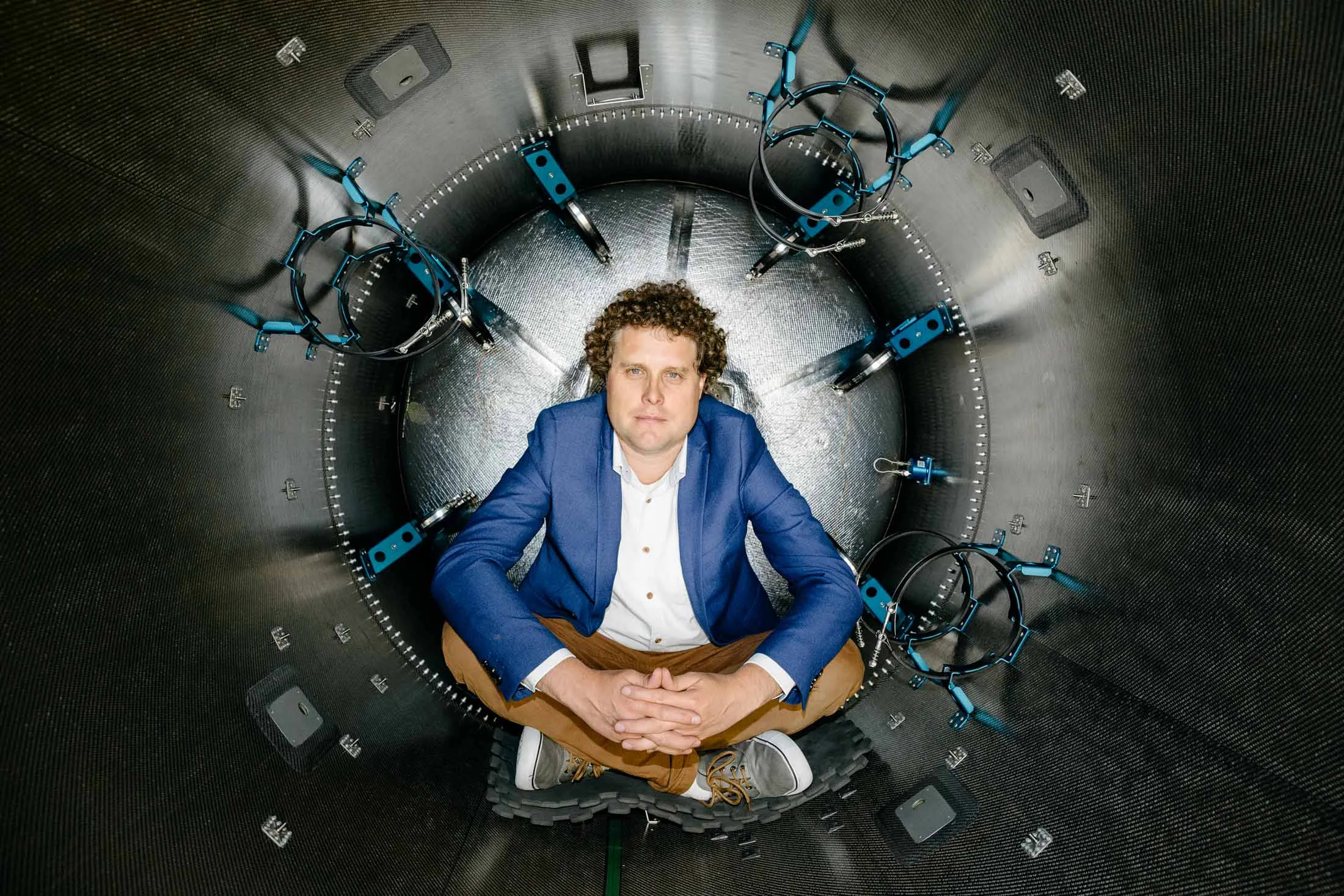
‘Building the first rocket was hard. Building the same rocket over and over again is 100 times harder’.
From the Edge of the World to the Edge of Space
The typical rocket company founder comes from elite aerospace institutions or the defence establishment. Peter Beck fits none of those profiles. He has no engineering degree nor a degree at all. He grew up in New Zealand, a country that historically had zero space industry. Against all odds, Beck pursued one of the most technically demanding industries in existence and built a company that is now widely regarded as the only credible launch provider besides SpaceX.
Building Rockets Without a Playbook
From an early age he was drawn to building engines and machines. Founded in 2006 with minimal capital and far from the aerospace supply chain, Rocket Lab developed rockets under severe constraints. Beck knew he could never outspend his competitors, so early days involved him wrecking parts from scrapyards and crawling over old machines. He echoed Rutherford’s saying ‘We have no money, so we have to think’.
Beyond the First Rocket
Rocket Lab first reached space in 2009 with the Ātea-1 sounding rocket, becoming the first private company in the Southern Hemisphere to do so. The far harder challenge, however, was building a repeatable orbital launch system. That system became Electron, a small-lift rocket designed for the emerging small-satellite market. Electron has since become the most frequently flown small launch vehicle in the world and the fastest rocket in history to reach fifty launches.
Unrelenting is Our Operating Principle
‘The team is just totally relentless, it’s just not acceptable to stop’
During a propulsion test late on a Friday afternoon, a hydraulic failure caused a catastrophic engine explosion that destroyed much of the test stand. Visitors were already in the air and scheduled to observe a test on Monday morning. Beck and team began rebuilding immediately. They rewired the facility, and redesigned elements of the engine. Nobody went home that weekend. By Monday morning the system was ready for another hot-fire test. The rebuilt engine performed 13% better than the original.
Credibility, Launch by Launch
Unlike much of the space industry, plagued by promotional 3D renders and ambitious promises, Beck has focused on reliable launches which allowed Rocket Lab to build elite credibility with commercial, civil, and defence customers. With 200+ satellites delivered to orbit, and a over two billion dollars in backlog, Rocket Lab today occupies a position very few believed possible two decades ago.
‘Execution is what matters most… anyone can promise capabilities, but we are delivering.’
‘If you take my salary, bonus, and stock, that employs a lot of engineers. I’d rather put it back into the business to hire more people and create more value.’ In March 2026, he voluntarily amended his employment agreement to reduce his annual salary to just $1 and waived all entitlement to future bonuses.
The next chapter of Beck’s story will be Neutron, Rocket Lab’s medium-lift rocket designed to enter a much larger segment of the launch market. Neutron would move the company into constellation deployment, national security missions, and larger payloads. For Beck, it would simply be the next proof that credibility, as he insists, is earned the same way it always has been – through execution.