

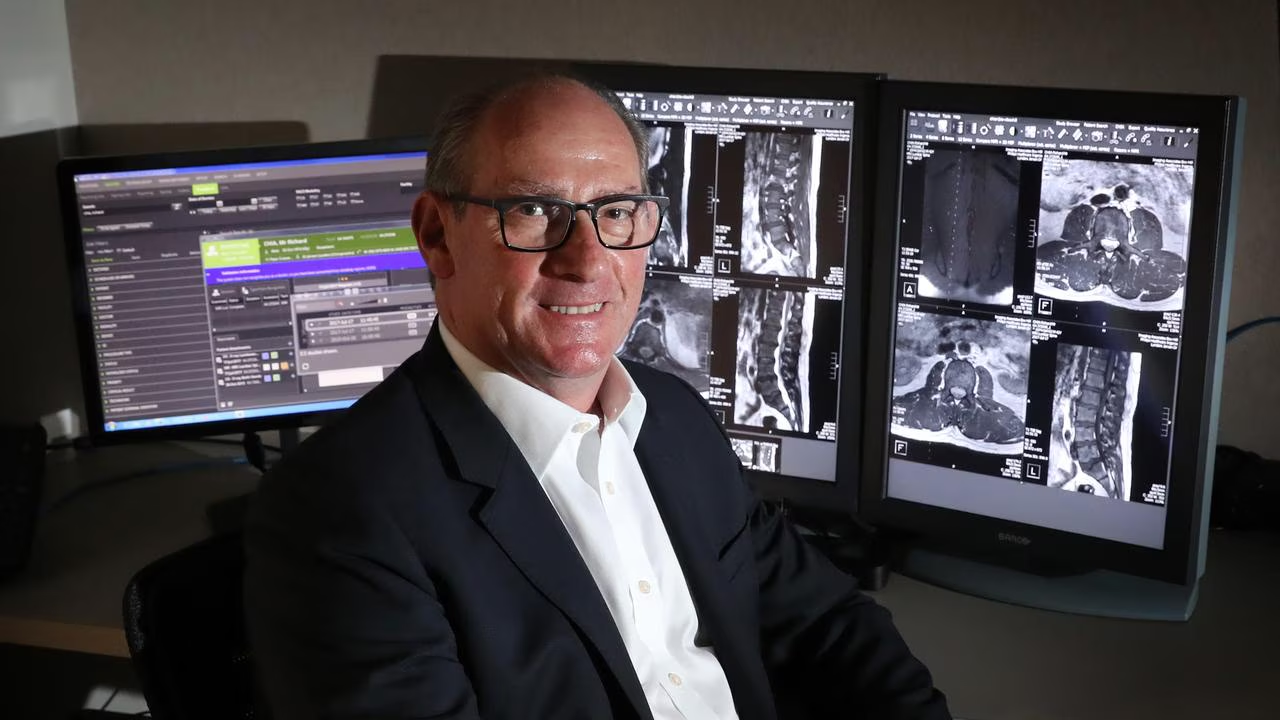
‘Hospitals don’t change their imaging systems lightly. When they do, they want something that’s a lot better. We’re not trying to be a little bit better than the incumbents; we aim to be multiples better’.
From Curious Clinician to Healthcare Software Pioneer
Australian born Sam Hupert’s early curiosity for how complex systems work, underpinned by a strong aptitude for science and problem solving, led him to train and begin his career as a general practitioner. It was during his early years in clinical practice that he became acutely aware of the persistent inefficiencies and workflow bottlenecks embedded across the medical system. To Sam these shortcomings were not inherent to medicine, they were solvable problems. A pivotal moment came in 1983 at a wine tasting event, where Sam met computer science engineer Anthony Hall. What began as a shared appreciation for a red wine quickly evolved into a meeting of minds around technology and its potential to transform healthcare delivery. Within months of discussion and planning, they co-founded Pro Medicus with the simple but ambitious aim of digitising medical workflows and enabling clinicians to work faster and more effectively.
Pioneering the Digitisation of Medical Workflows
The task they set themselves was anything but easy. At the time computing was still in its early stages of adoption and few companies were building vertical-specific software for the sector. The industry, particularly radiology, was still dominated by paperbased processes, manual scheduling, and fragmented billing systems. Yet radiology also offered a compelling opportunity with high patient volumes and a landscape of independent practices that were more agile and receptive to change. Building trust, reliability, and demonstrable value in clinical workflow systems required patience and precision. As they were operating in a market where venture capital was far less accessible than in the United States, they self-funded and built a system focused on solving radiology workflow bottlenecks in Australia. Over time, Pro Medicus steadily emerged as the leading radiology information system (RIS) provider in the region.
Strategic Pivot and Realignment
The company’s defining inflection point came decades into its development. In 2007, Sam stepped away from day‑to‑day operations, transitioning from CEO to non‑executive chairman. However, the Global Financial Crisis presented a rare strategic opportunity. Pro Medicus acquired Visage Imaging for just $6 million from a distressed seller, an asset that would fundamentally reshape the company’s trajectory. Recognising the strategic importance, Sam returned as CEO to refocus the business on scaling its missioncritical imaging software offering. Equally important was his decisive shift in the company’s commercial model, moving away from large upfront software licence fees to a transaction-based pricing structure. This realignment better matched hospital economics, removed adoption friction, and opened the door to the largest healthcare systems in the United States.
A ‘40-year overnight success story’
Pro Medicus has evolved into a leading global technology imaging platform, underpinned by a formidable competitive moat built around its cloud‑native, high‑performance architecture. The platform enables rapid deployment, superior image rendering speeds, and materially higher workflow efficiency relative to legacy systems. This advantage is particularly relevant as the industry confronts a tightening supply of radiologists and sustained growth in healthcare costs. While Sam describes Pro Medicus as a ‘40‑year overnight success story’ , its trajectory speaks to something more enduring, that is, a founder with the patience to pursue a long‑term vision, disciplined execution, and the conviction to build software that is significantly better than the incumbent systems it replaces.