Investor Portal

Jensen Huang, Nvidia

Reading Time: 3 minutes

‘We don’t steal market share, we create markets.’

Bottom Up

Jensen Huang has never been afraid to get his hands dirty. Born in Taiwan in 1963, he was sent at nine to a Kentucky school for troubled children, which his parents had mistaken for a respectable boarding school. Much younger than his classmates, he was bullied and assigned to clean the dorm bathrooms. As a teenager, he worked his way up from dishwasher and bathroom cleaner to waiter at a Denny’s diner. As he likes to say, ‘I did more bathrooms than any CEO in the history of CEOs.’

Ahead of his years and gifted at maths, Jensen enrolled at Oregon State University at 16 to study electrical engineering, the start of a path that led to designing chips at AMD and LSI Logic. There, he recognised that computer processors handled tasks one at a time, while the hardest problems, from 3D graphics to scientific simulation, needed millions of calculations at once. To Jensen this was not a limit of computing, but a market no one had yet built.

In late 1992, Jensen returned to Denny’s with a much bigger idea. Over bottomless coffee in a San Jose booth, he and fellow engineers Chris Malachowsky and Curtis Priem worked out how to build a company around it. In 1993, with just US$40,000 between them, they founded Nvidia. The name came from invidia, the Latin word for envy, an apt choice for a business that would one day be the envy of the technology world.

Turning Failure into Edge

The early years nearly ended the company. Nvidia’s first chip failed to find buyers, and a contract with Sega to build the graphics chip for its next console became its lifeline. A year in, Jensen realised Nvidia had backed the wrong design. As he put it, ‘we would finish the project and die, or not finish the project and die right away.’ He flew to Japan, admitted to Sega’s chief executive that Nvidia’s design was flawed and advised him to find another partner. Then he made a bold request: that Sega pay Nvidia anyway, because without the money the company would not survive. Remarkably, Sega agreed to invest US$5 million. It was enough to keep the lights on for about six months, and Nvidia would not waste a day of it.

The problem ran deeper than one chip. As Jensen admitted, ‘Not only did we choose the wrong technology, we didn’t know how to do it the right way.’ He bought three textbooks on 3D graphics, and the team learned the industry standard from scratch. With no time or money for the usual cycle of prototypes, Jensen spent about a third of Nvidia’s remaining cash on an emulator to test the chip in software. Nvidia went straight to production without a working prototype, an approach almost unheard of at the time. Launched in 1997, the RIVA 128 sold more than a million units in four months and saved the company. Emulation became standard practice, letting Nvidia release new chips every six months while rivals took twice as long.

Tomorrow’s Market has no Customers Today

Nvidia’s most consequential decision came in 2006 with CUDA, the software that took the GPU beyond graphics Jensen built it into every chip, weighing on profits for years as investors questioned the strategy. He believed scientists and engineers would one day need that kind of computing power. The breakthrough came in 2012, when researchers used Nvidia graphics cards to train AlexNet, an AI model that taught itself to recognise images. Its success kick-started the deep learning revolution.

As AI models grew, so did the computing power needed to train them. Nvidia responded by building complete systems, linking thousands of GPUs into what Jensen calls ‘AI factories.’ The graphics chipmaker had become the foundation of modern AI.

The World’s Most Valuable Company, Ever

More than three decades after that Denny’s booth, Nvidia is closing in on a US$6 trillion valuation, the highest of any company in history. Yet behind the seemingly overnight rise is a founder who refused to let Nvidia fail, had the humility to change course when his design was wrong and backed CUDA years before it paid off. His greatest successes have come not from winning existing markets, but from creating new ones.
Coinbase

Reading Time: 3 minutes

Coinbase is the leading U.S. cryptocurrency exchange and custody platform; effectively the “picks and shovels” provider of the digital-asset economy. Founded in 2012 by Brian Armstrong and Fred Ehrsam, Coinbase has become the most trusted gateway for both retail and institutional participants, serving over 120 million verified users and holding more than US $500 billion in customer assets. It dominates the U.S. retail crypto market and anchors the institutional ecosystem as custodian and execution partner for nearly all newly approved Bitcoin and Ethereum ETFs.

The Blockchain Decade

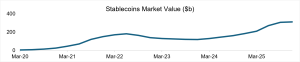
Stablecoins settled roughly US $46 trillion in 2025, more than Visa and Mastercard combined across a broader range of financial activity. At the same time, regulatory clarity in the U.S. (stablecoin GENIUS Act and CFTC comprehensive proposal) and Europe is unlocking institutional participation, with asset managers, banks, and fintechs seeking compliant partners. Particularly in the U.S., the White House has launched a coordinated push to position the nation as “the Crypto Capital of the World.”

Arms Strong

Armstrong’s philosophy “an open financial system for the world” has guided Coinbase from exchange to full-stack infrastructure provider. A self-described “product-focused CEO,” he has incessantly pursued long-range investments in compliance, custody, and developer platforms. Of the early major exchanges, nearly all failed, committed fraud, or fled offshore. This stability of vision and control has allowed Coinbase to expand into staking, stablecoins, and on-chain infrastructure without losing focus on regulatory legitimacy; the central differentiator of the franchise.

License as Moat

Coinbase is the most regulation-ready and audit-hardened platform at scale in crypto. From inception, it chose to operate transparently under U.S. and global financial regulations. This compliance-first DNA has now become a durable advantage as regulators tighten standards and many offshore or underregulated competitors retreat or unwind. Coinbase is the natural partner for institutions, ETFs and banks that require compliant infrastructure.

The ‘Amazon’ of Crypto

Coinbase is becoming more than a place to buy and sell crypto. Trading brings customers in; custody and staking keep their assets on the platform; USDC lets them move and spend money; and Base provides the infrastructure layer for a growing ecosystem of on-chain apps and financial activity. This means Coinbase can earn from the same customer in several ways. It makes money from trading and custody, whilst earning interest income through USDC.


Source: CoinGecko

How do AI Pay?

AI agents will increasingly need to pay for data, software and computing from one another. Many of these purchases could be fractions of a cent and occur thousands or millions of times automatically. Traditional card rails, with minimum fees, intermediaries and human accounts, are poorly suited to this kind of activity. Coinbase already has much of the infrastructure ready – USDC provides the money, Base moves it cheaply, and x402 lets AI agents pay businesses automatically over the internet. With x402 already processing more than 50 million transactions, Coinbase is becoming an important payment rail for the emerging machine economy, much as card networks enabled internet commerce.

Financials

Since listing, Coinbase’s revenue has grown ~59% annually. We model ~29% annual growth through FY31 as Coinbase expands beyond trading into the broader infrastructure of the on-chain economy: institutional custody and prime services, stablecoins and payments, staking, Base, and developer infrastructure. We forecast EBIT margins to expand from 22% toward ~34% by FY31 driven by software-like scalability, fewer intermediaries than in traditional brokerage, and a higher fee base (~30 bps vs 3 bps for equities).

Valuation

At current valuation levels (~35 forward P/E), Coinbase offers an attractive exposure to the most trusted operating system for the on-chain economy. Our Total Rate of Return estimate for the company is >20% pa over the next 5 years.

Fortinet

Reading Time: 2 minutes

Despite the backdrop of the “SaaSpocalypse” and a sharp derating across software, Fortinet has rallied 121% year to date. The performance reflects continued earnings delivery and growing recognition of a differentiated cybersecurity platform. Fortinet is a global leader in cybersecurity, serving over 900,000 customers through one of the industry’s most comprehensive and integrated security platforms. Founded in 2000 by brothers Ken and Michael Xie, the company has evolved from a firewall business into a broad security operating system.

Built for the Long Game

Ken and Michael Xie built Fortinet around the view that cybersecurity was fundamentally an infrastructure-engineering problem. Their leadership has been defined by long-term vision, organic innovation and an engineering-driven culture. While hardware was increasingly viewed as legacy, the Xie brothers doubled down on proprietary ASICs and a single FortiOS architecture. Over 25 years, that conviction has transformed Fortinet from a firewall vendor into an integrated platform spanning more than 50 enterprise-grade products, while delivering superior security performance at lower cost.

A Growing Need for Security

Fortinet operates across a large and expanding cybersecurity market exceeding US$184bn, including Secure Networking, Unified SASE and AI-driven Security Operations. Rising cyber complexity, AI-driven attack volumes and the convergence of networking and security are increasing the need for real-time, cost-efficient protection. At the same time, enterprises are increasingly consolidating fragmented security stacks, favouring integrated platforms such as Fortinet.

Architecture Advantage

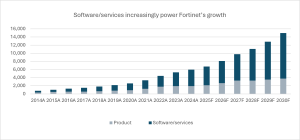
Fortinet has built one of the industry’s most deeply integrated cybersecurity architectures, combining proprietary hardware, software and security intelligence under a single operating system. This reduces R&D duplication, improves deployment efficiency and enables ASIC-accelerated performance. FortiGate also provides a powerful entry point into customers – around 90% begin with the firewall before expanding into SASE, XDR, email and other security products. Evidently, Fortinet has delivered a 10-year revenue CAGR of 23%, including 26% growth in services.

Source: Company filings, Ziller expectations. Forecasts subject to change.

A Lesson in AI

Fortinet may also be an early example of a broader reappraisal now taking place across software. In that AI disruption will not affect every software business equally. As sentiment begins to recover across the sector, we believe the opportunity lies in distinguishing businesses with durable data, workflows, architecture and competitive advantages from those whose value can be more easily commoditised.

A Winner at a Fuller Valuation

Fortinet has been a strong investment for Ziller, with the underlying thesis playing out through continued market-share gains, earnings growth and platform expansion. That said, the significant share-price appreciation over the past year has reduced the prospective TRR from previous levels. We have therefore begun trimming the position, realising gains while still retaining exposure to a high-quality cybersecurity leader.

The Founder Constant

Reading Time: 2 minutes

Every generation tends to regard its era as historically unique. The dominance of founder-led companies built by figures such as Jeff Bezos, Bill Gates, Jensen Huang and Elon Musk can make founder advantage seem like a byproduct of software, the internet or AI. They appear singular because the technologies they command are new, the scale of their companies is immense, and the systems around them feel unprecedented. Yet this is not new.

The Same Pattern

The clearest way to understand this is to look at past products and focus on the few key people that drove them. In the 18th century, Richard Arkwright helped industrialise production through mechanised textiles. A century later, during The Gilded Age, Andrew Carnegie supplied the material backbone of America through steel, Thomas Edison helped commercialise electrification at system scale, John D. Rockefeller organised the oil base of the industrial age. Whilst not too long ago, Gordon Moore stood at the centre of the semiconductor revolution.

These were not marginal developments, in fact, steam and textiles accounted for roughly 28% of GDP growth in their era, railways 17%, steel and electrification 14%, oil 16%, and semiconductors 14%.

It is not simply that these were important industries. It is that, across radically different periods, economic growth repeatedly concentrated around a small number of foundational themes, and the leading founders around those themes captured disproportionately extraordinary value.

Few Who Shape the Many

As Peter Thiel observes:

“Never forget that a small group of highly competent but slightly absurd folks can change the world; indeed, it’s the only thing that ever has.”

Of the 50 US-listed companies that have generated the most shareholder wealth since 1926, 31 were founder-led at some point during their public lives. Ranked by annualised returns, 17 of the top 20 were founder-led.

It includes familiar names such as Steve Jobs (Apple), Bill Gates (Microsoft), Jeff Bezos (Amazon), Mark Zuckerberg (Meta), and Larry Ellison (Oracle), but also founders from much earlier eras and very different sectors, including Sam Walton (Walmart), Walt Disney (Disney), and Bernie Marcus (Home Depot).

Why This Still Matters Today

Seen this way, the defining founders of the present are not without precedent. The enduring point is that founder-led outperformance has accompanied every major period and is why the strongest founders continue to matter so much.

In an era of unseen pace of change and new questions, this principle becomes even more powerful. As Jim Collins argues in his book Good to Great,

“The more uncertain the world, the more you want to bet on the who, not the what, because the what’s are going to change.”

SpaceX

Reading Time: 3 minutes

SpaceX is the defining company of the new space economy. Founded by Elon Musk in 2002 to make humanity multiplanetary, the company has transformed launch from a bespoke aerospace activity into a reusable, high-volume industrial platform. It now controls the core physical layers behind the next generation of space infrastructure; low-cost launch, satellite manufacturing, global connectivity, and increasingly (terrestrial) AI compute. In 2025, SpaceX completed 170 launches, carried 2,200 metric tons to orbit – more than the rest of the world combined – and represented more than 80% of all mass launched to orbit.

The Algorithm

Elon Musk’s defining contribution has been to reframe aerospace through first-principles engineering and industrial scale. SpaceX was founded on the belief that rockets were expensive not because of physics alone, but because of inefficient processes, fragmented supply chains, and low-volume production. Musk’s response was to vertically integrate aggressively, simplify systems, iterate rapidly, and continuously compress cost curves. The company formalised this philosophy internally through “The Algorithm”: question requirements, delete unnecessary parts and processes, optimise only what remains, accelerate cycle time, and automate last.

Industrialisation of Space

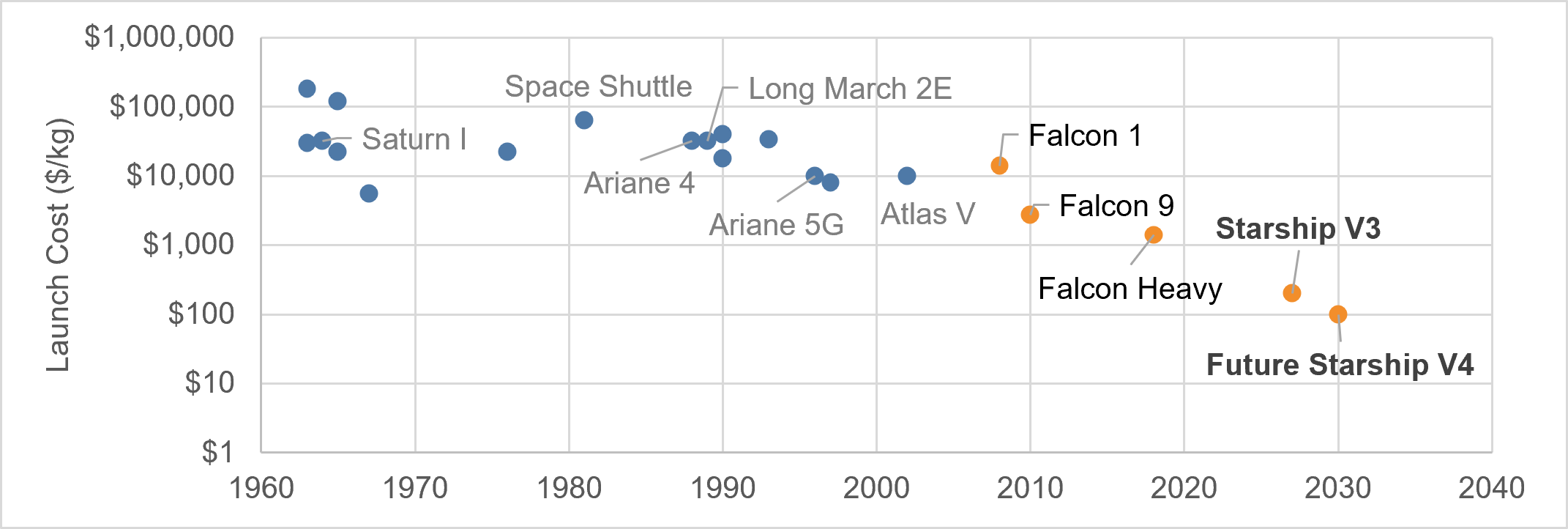
Starlink is the clearest commercial proof of SpaceX’s launch advantage. It converts low-cost access to orbit into recurring revenue. On a scale unmatched, Starlink operates over 9,600 satellites and represented roughly 75% of all active maneuverable satellites in orbit. Starship, the largest and most powerful vehicle of any kind ever developed, is designed to carry over 100 metric tons to orbit in a fully reusable configuration, which will materially lower the cost of deploying satellites, communications infrastructure, and orbital compute.

Source: SpaceX and Ziller Funds Management | Constant 2021 $ per kilogram; plotted on a logarithmic axis

Orbit, Bandwidth and Compute

SpaceX is the only owner across all three scarce physical capacity – orbit, bandwidth, and compute. The company frames its long-term opportunity around a very large addressable market, estimating a quantifiable TAM at approximately $28.5tn, including $370bn in Space, $1.6tn in Connectivity, and $26.5tn in AI. Importantly, these markets reinforce one another. Launch enables satellites. Satellites enable global bandwidth. Bandwidth supports compute distribution. Distributed compute creates the next major infrastructure layer, AI.

SpaceX’s AI strategy is therefore an extension of the same playbook. AI growth is increasingly constrained by power, chips, and data centre construction. SpaceX’s “from shovels to tokens” approach attacks these bottlenecks directly by controlling physical infrastructure from power generation through to compute deployment. The Anthropic and Google agreement, under which SpaceX will provide access to COLOSSUS and COLOSSUS II capacity for $2.1bn per month through 2029, demonstrates that compute infrastructure is already monetisable at scale.

Valuation

The value of launch providers such as SpaceX and Rocket Lab has rallied substantially across public and private markets over the past few years. Ziller Global Fund has participated in this rally through our investment in Rocket Lab since late 2024. Given the elevated valuation at IPO, we chose not to participate in the SpaceX offering, but continue to monitor the stock closely for an attractive entry point.

SpaceX is expected to grow revenue by 81% in FY26, 61% in FY27, 49% in FY30, driven primarily by Starlink and terrestrial data centre monetisation. Our current Total Rate of Return estimate for SpaceX is approximately 10% p.a. over the next five years. Near term, the factors we are monitoring most closely are the pace of terrestrial data centre buildout, achieved compute rental rates, and progress in AI model monetisation (Cursor and broader enterprise adoption).

Peter Beck, Rocket Lab

Reading Time: 2 minutes

‘Building the first rocket was hard. Building the same rocket over and over again is 100 times harder’.

From the Edge of the World to the Edge of Space

The typical rocket company founder comes from elite aerospace institutions or the defence establishment. Peter Beck fits none of those profiles. He has no engineering degree nor a degree at all. He grew up in New Zealand, a country that historically had zero space industry. Against all odds, Beck pursued one of the most technically demanding industries in existence and built a company that is now widely regarded as the only credible launch provider besides SpaceX.

Building Rockets Without a Playbook

From an early age he was drawn to building engines and machines. Founded in 2006 with minimal capital and far from the aerospace supply chain, Rocket Lab developed rockets under severe constraints. Beck knew he could never outspend his competitors, so early days involved him wrecking parts from scrapyards and crawling over old machines. He echoed Rutherford’s saying ‘We have no money, so we have to think’.

Beyond the First Rocket

Rocket Lab first reached space in 2009 with the Ātea-1 sounding rocket, becoming the first private company in the Southern Hemisphere to do so. The far harder challenge, however, was building a repeatable orbital launch system. That system became Electron, a small-lift rocket designed for the emerging small-satellite market. Electron has since become the most frequently flown small launch vehicle in the world and the fastest rocket in history to reach fifty launches.

Unrelenting is Our Operating Principle

‘The team is just totally relentless, it’s just not acceptable to stop’

During a propulsion test late on a Friday afternoon, a hydraulic failure caused a catastrophic engine explosion that destroyed much of the test stand. Visitors were already in the air and scheduled to observe a test on Monday morning. Beck and team began rebuilding immediately. They rewired the facility, and redesigned elements of the engine. Nobody went home that weekend. By Monday morning the system was ready for another hot-fire test. The rebuilt engine performed 13% better than the original.

Credibility, Launch by Launch

Unlike much of the space industry, plagued by promotional 3D renders and ambitious promises, Beck has focused on reliable launches which allowed Rocket Lab to build elite credibility with commercial, civil, and defence customers. With 200+ satellites delivered to orbit, and a over two billion dollars in backlog, Rocket Lab today occupies a position very few believed possible two decades ago.

‘Execution is what matters most… anyone can promise capabilities, but we are delivering.’

‘If you take my salary, bonus, and stock, that employs a lot of engineers. I’d rather put it back into the business to hire more people and create more value.’ In March 2026, he voluntarily amended his employment agreement to reduce his annual salary to just $1 and waived all entitlement to future bonuses.

The next chapter of Beck’s story will be Neutron, Rocket Lab’s medium-lift rocket designed to enter a much larger segment of the launch market. Neutron would move the company into constellation deployment, national security missions, and larger payloads. For Beck, it would simply be the next proof that credibility, as he insists, is earned the same way it always has been – through execution.

Money Forward

Reading Time: 2 minutes

Money Forward is a leading cloud-based platform serving individuals, SMBs, and mid-sized enterprises in Japan. The company provides a comprehensive suite of back-office solutions, including accounting, HR, legal, marketing, and personal finance management. Since its founding in 2012 by Yosuke Tsuji, it has grown both organically and through strategic acquisitions, establishing itself as a dominant player in Japan’s accounting SaaS market. Its AI-powered, fully integrated software ecosystem, which is deeply connected with local banks and payment networks, continues to drive market share gains by eliminating operational bottlenecks and boosting enterprise productivity.

Yosuke Tsuji’s Long Game

Founder and CEO Yosuke Tsuji has entrenched a customer-centric culture and strategic vision that transformed Japan’s financial infrastructure. His leadership pioneered open banking in a conservative ecosystem, solved critical productivity challenges for SMEs, and prioritised sustainable ecosystem growth over short-term gains. With deep industry influence and alignment through significant equity ownership, Tsuji remains the key architect of Money Forward’s competitive moat and long-term strategy.

The SaaS Catch-Up

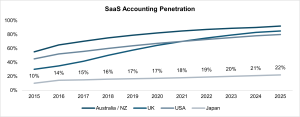
Japan’s SaaS adoption remains low at roughly 22%, far behind mature markets such as Australia/New Zealand (92%), the UK (85%), and the US (80%). This gap underscores a substantial growth runway as regulatory mandates, such as mandated electronic receipt retention, drive the remaining 78% of legacy systems toward inevitable digitisation. The industry benefits from favourable economics characterised by strong customer retention, scalability, pricing power and high incremental returns.

Source: Company filings, Ziller estimates1

Competitive Moat within a Large Addressable Market

Money Forward operates in a substantial total addressable market (TAM) of approximately ¥6.7 trillion across five domains, with the largest back-office SaaS segment estimated at ¥2.3 trillion. Serving over 425,000 business customers, the company has significant whitespace to expand across all segments. Its durable competitive moat is anchored by its cloud-native architecture, a comprehensive product suite, efficient accounting firm distribution network, and a deeply embedded customer-centric culture. Strategic priorities focusing on core B2B SaaS, accelerating AI-driven efficiencies, and expanding into the mid-market position Money Forward to achieve long-term margin expansion and profitability targets of 30% by FY2028.

Valuation

Money Forward offers a compelling valuation profile, trading at a discount to global and local peers despite superior growth metrics and a net cash balance sheet. With a Price/Sales of 3.9x (versus Xero at 6.8x/Intuit at 8.3x) and a robust growth trajectory, our Total Rate of Return estimate for the company is >20% pa over the next 5 years.

Sam Hupert, Pro Medicus

Reading Time: 2 minutes

‘Hospitals don’t change their imaging systems lightly. When they do, they want something that’s a lot better. We’re not trying to be a little bit better than the incumbents; we aim to be multiples better’.

From Curious Clinician to Healthcare Software Pioneer

Australian born Sam Hupert’s early curiosity for how complex systems work, underpinned by a strong aptitude for science and problem solving, led him to train and begin his career as a general practitioner. It was during his early years in clinical practice that he became acutely aware of the persistent inefficiencies and workflow bottlenecks embedded across the medical system. To Sam these shortcomings were not inherent to medicine, they were solvable problems. A pivotal moment came in 1983 at a wine tasting event, where Sam met computer science engineer Anthony Hall. What began as a shared appreciation for a red wine quickly evolved into a meeting of minds around technology and its potential to transform healthcare delivery. Within months of discussion and planning, they co-founded Pro Medicus with the simple but ambitious aim of digitising medical workflows and enabling clinicians to work faster and more effectively.

Pioneering the Digitisation of Medical Workflows

The task they set themselves was anything but easy. At the time computing was still in its early stages of adoption and few companies were building vertical-specific software for the sector. The industry, particularly radiology, was still dominated by paperbased processes, manual scheduling, and fragmented billing systems. Yet radiology also offered a compelling opportunity with high patient volumes and a landscape of independent practices that were more agile and receptive to change. Building trust, reliability, and demonstrable value in clinical workflow systems required patience and precision. As they were operating in a market where venture capital was far less accessible than in the United States, they self-funded and built a system focused on solving radiology workflow bottlenecks in Australia. Over time, Pro Medicus steadily emerged as the leading radiology information system (RIS) provider in the region.

Strategic Pivot and Realignment

The company’s defining inflection point came decades into its development. In 2007, Sam stepped away from day‑to‑day operations, transitioning from CEO to non‑executive chairman. However, the Global Financial Crisis presented a rare strategic opportunity. Pro Medicus acquired Visage Imaging for just $6 million from a distressed seller, an asset that would fundamentally reshape the company’s trajectory. Recognising the strategic importance, Sam returned as CEO to refocus the business on scaling its missioncritical imaging software offering. Equally important was his decisive shift in the company’s commercial model, moving away from large upfront software licence fees to a transaction-based pricing structure. This realignment better matched hospital economics, removed adoption friction, and opened the door to the largest healthcare systems in the United States.

A ‘40-year overnight success story’

Pro Medicus has evolved into a leading global technology imaging platform, underpinned by a formidable competitive moat built around its cloud‑native, high‑performance architecture. The platform enables rapid deployment, superior image rendering speeds, and materially higher workflow efficiency relative to legacy systems. This advantage is particularly relevant as the industry confronts a tightening supply of radiologists and sustained growth in healthcare costs. While Sam describes Pro Medicus as a ‘40‑year overnight success story’ , its trajectory speaks to something more enduring, that is, a founder with the patience to pursue a long‑term vision, disciplined execution, and the conviction to build software that is significantly better than the incumbent systems it replaces.

The Founders’ Advantage

Reading Time: 4 minutes

Why Founder‑Led Companies Drive Superior Long‑Term Returns

Building a durable and profitable business in a rapidly shifting landscape demands more than a compelling strategy or innovative products. Business models and sectors matter, but the real differentiator is leadership. Across industries and market cycles, one pattern remains strikingly consistent. Founder led companies outperform those run by professional management.

Academic studies and our proprietary analysis reinforce this. Within the S&P 500, companies with founders still deeply involved have outperformed their peers tenfold over the last 30 years. The explanation is straightforward, founders think, operate, and lead differently. They tend to exhibit greater resilience during downturns and capture more upside during expansions.

At Ziller Funds Management, founder driven leadership is the cornerstone of our investment philosophy. We invest exclusively in high growth companies led by exceptional founders because this is where long term value creation resides.

Exposure to Winners: Where Long Term Wealth Is Created

Market wealth creation is extraordinarily concentrated. Hendrik Bessembinder’s landmark study (1990-2020) found that half of all global market wealth creation is powered by a small subset of standout companies. Within this group, our research suggests half of the value was generated by founder-led businesses, despite representing only 11–12% of companies in the index. Their disproportionate influence on returns is remarkable. Bessembinder also concluded in a US market study (1925-2023) that 52% of U.S. stocks delivered negative lifetime cumulative returns, underscoring the importance of selectivity. NVIDIA, Netflix, Amazon, and Axon exemplify this pattern: founder built and engineered to excel through both crisis and opportunity.

Why Founders Win

Founders possess a rare combination of vision, ownership, resilience, and mission-driven focus. Chris Zook (2016) described these traits as the “Founder Mindset,” a leadership DNA that shapes a company’s culture and cascades through the entire organisation. He highlights that their frontline obsession empowers employees closest to customers. A powerful example is M. S. Oberoi of Oberoi Hotels, who well into his nineties, with his eyesight so poor that his nose almost touched the paper, handwrote responses to guest comment cards. That simple act became cultural doctrine: the guest comes first; leadership is service. Founders pair this customer obsession with an owner’s mindset, cutting bureaucracy, allocating capital decisively, and safeguarding long term interests. They also operate with business insurgency, a mission-driven energy that pushes them to challenge norms, reshape industries, and win loyalty by solving what incumbents overlook.

How We Harness This Advantage

The Ziller Global Fund is designed to harness the founder-led advantage by identifying founders with the discipline, adaptability, and conviction to build extraordinary businesses over decades. To operationalise this, we developed a proprietary founder led index, our global hunting ground for ideas. This diversified equity universe is curated exclusively for founder led businesses and has delivered approximately 7% p.a. alpha versus broad markets over the long term, aligning with both corporate and academic evidence supporting the outperformance of founder led businesses.

Not All Founders Excel

Being a founder alone is no guarantee of success. The gulf between exceptional founders and poor ones is wide. Some founder‑led firms stagnate, become bureaucratic, erode competitive advantages, or resist technological change, particularly in the age of AI. We avoid these. Our investment process applies both qualitative filters and a quantitative checklist so that we only focus on the best founders – we look for aligned, purpose driven founders with the courage to challenge the status quo and the track record to prove it.

Surviving and Thriving: Why Resilient Founders Excel

Founders are often admired for their vision, but it is their resilience that truly distinguishes the exceptional ones. The leaders we back are not newcomers to turbulence; they are seasoned navigators who have steered their companies through multiple downturns and emerged stronger. While the median global CEO tenure is about 4.8 years, founders in our portfolio average 19 years at the helm. Over time, they have weathered failures, strategic pivots, and recoveries building organisational “muscle memory” that becomes invaluable in volatile environments. For example, Mercardo Libre founder Marcos Galperin endured the dot com crash by making difficult strategic cuts, refocusing on core markets, and forging a crucial alliance with eBay. These decisions not only ensured survival but laid the foundation for long term dominance.

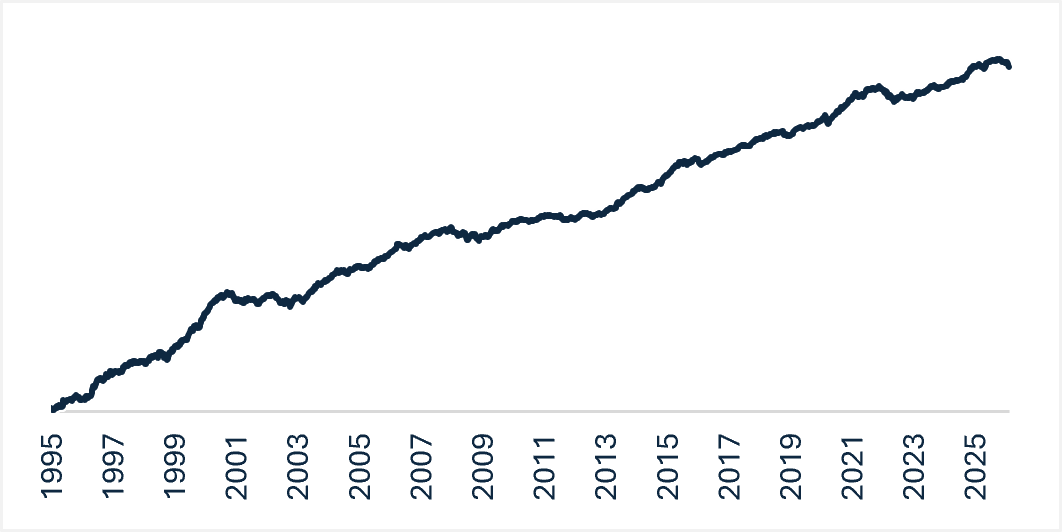
Every founder we back has their own version of this story. Our 30 year Founder Index reflects this repeatedly: exceptional founder led companies weather downturns better and rebound faster, supported by the data and decades of lived experience.

Ziller Q1 Founders surviving and thriving through market volatility

Source: Ziller Q1 Founder Index (AUD), weekly prices from LSEG, log chart

Sourcing Strong Businesses with Structural Tailwinds

Behind every high performing founder in our portfolio is a business with a resilient economic architecture: a growing economic moat, structural tailwinds, capital light efficiency, limited competition, large addressable markets and accelerating earnings. These traits typically manifest in high incremental return on equity, the fuel for long term compounding.

Margin of Safety

Valuation is the final step in our process. We seek companies with a high risk-adjusted Total Rate of Return (TRR). A high TRR expands the margin of safety in the purchase price and reduces the risk of future loss.

The Ziller Global Fund Advantage

Through the Ziller Global Fund, investors gain intentional exposure to the rare founders who consistently deliver outlier outcomes. We are not speculating on untested management teams; we are partnering with proven survivors and builders.

Our investment process is deliberately people first because we believe long term compounding begins with the calibre of the person at the helm. These are not ordinary leaders. They are the engines of long term market wealth creation.

Marcos Galperin, Mercado Libre

Reading Time: 2 minutes

‘Take risks. If you have a contrarian view, just pursue it. But you’ll need to be resilient and long-term focused’.

From Stamps to Start-ups

Marcos Galperin’s entrepreneurial spark ignited early. At just ten years old, he was selling stamps to collectors, a small venture that hinted at the transformational leader he would become. Fast forward to 1999: while completing his MBA at Stanford, the Argentinian-born visionary set his sights on a challenge many deemed impossible: building an e-commerce platform for Latin America. He called it Mercado Libre, meaning “free market,” a name that captured his mission to democratise online commerce and financial services in a region with vast populations but limited digital infrastructure. Starting with a niche he knew best, connecting buyers and sellers of collectible items, he later expanded to a full spectrum of products.

Turning Obstacles into Opportunities

The odds were stacked against him. Internet penetration was below five percent, payment systems and delivery networks were virtually non-existent, and regulatory frameworks were still in their infancy. Sceptics argued that e-commerce could never succeed in such an environment. Marcos thought differently. He turned structural obstacles into opportunities, later launching Mercado Pago to solve payment friction and Mercado Envios to tackle logistical hurdles.

Surviving and Thriving

His resilience was tested during the dot-com crash when venture capital evaporated. While others folded, Marcos acted decisively – cutting costs, shutting down non-essential operations, and concentrating resources on core markets like Brazil, Argentina, and Mexico. A strategic alliance with eBay in 2001, which included a 19.5% stake, brought much-needed capital, credibility, and technical expertise. These moves ensured Mercado Libre not only survived but laid the foundation for long-term dominance.

Strategic Patience and Customer Obsession

From the outset, Marcos embraced a multi-decade vision. He favoured organic growth and strengthening internal capabilities over rapid expansion through acquisitions. His approach embraced calculated risks with longer payback periods, prioritising sustainable returns over short-term wins. Market cycles, in his view, were part of the learning journey. Above all else, he placed unwavering focus on the customer. Every decision begins with a single question: “What is the impact on the user’s experience?” This unwavering focus on trust and user experience is deeply ingrained in Mercado Libre’s DNA and remains a cornerstone of its success.

Latin America’s Digital Powerhouse

Marcos Galperin’s long-term vision has become a reality. Mercado Libre has evolved into Latin America’s most comprehensive and unrivalled e-commerce and fintech ecosystem, operating across 18 countries and serving more than 107 million active customers. The company continues to lead the region’s digital transformation. With e-commerce penetration still at just 14%, well behind the UK and US (30% and 26% respectively), the market remains largely untapped, offering an extraordinary runway for sustained growth and innovation.